

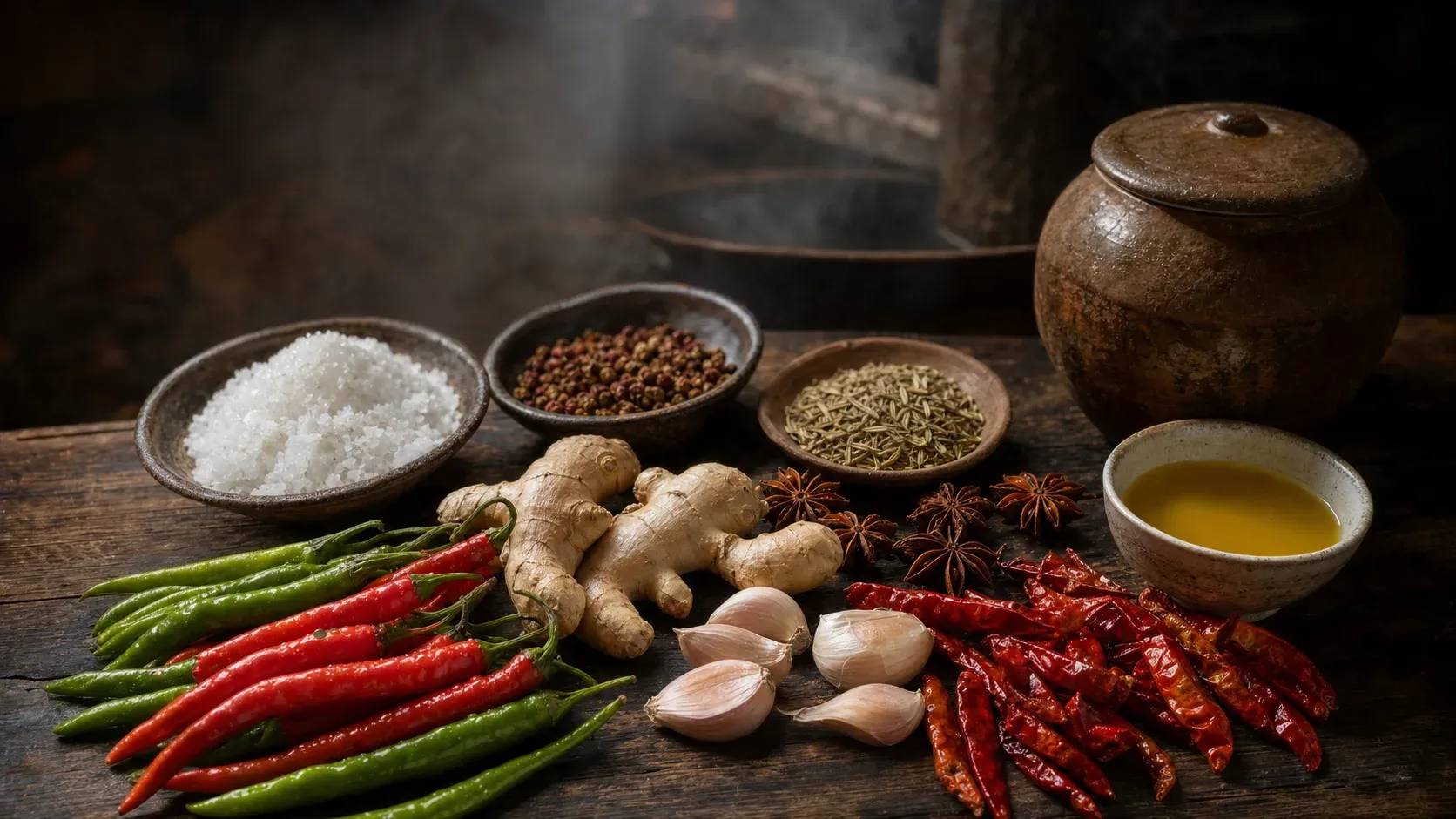
The Spice System of Zigong Salt-Industry Cuisine
Preface: Aroma Grows from Salt-Field Life
To discuss the spice system of Zigong Salt-Industry cuisine, one first has to look back at salt wells, guild halls, markets, and home stoves. Zigong has nearly two thousand years of well-salt production history, with well-salt production already present during the reign of Emperor Zhang of the Eastern Han dynasty. Over time, the city formed a way of life centered on well-salt culture.[1] Salt gives food its base flavor, and it also gives spices an order to attach to.
Zigong Salt-Industry cuisine evolved from salt-field cooking. Local materials summarize it as thick in flavor, rich in aroma, fresh, hot, and stimulating, while placing that flavor within the background of a salt-industry economy, an immigrant city, and multi-layered food consumption.[2] For that reason, spices in Zigong cooking rarely appear as isolated plants. They usually work together with well salt, rapeseed oil, doubanjiang, sun-dried vinegar, pickles, fresh chili, young ginger, and heat control, eventually forming a flavor method that can move among small-pan frying, quick frying, dry-frying, cold-eat dishes, and huo du.
 A spice system is not one finished dish. It is a craft order built from well salt, fresh chili, young ginger, Sichuan pepper, dried chili, pickle jars, and rapeseed oil.
1. Well Salt and the Base of Seasoning
Salt is the first layer of this system. A Sichuan Provincial Gazetteer repost of Zigong local materials notes that salt is both a daily necessity and a food seasoning that can stimulate other tastes. The same text discusses Zigong well-salt condiments, Taiyuan Well sun-dried vinegar, aged sun-dried vinegar, Fushun spicy sauce, qixing chaotian chili, Tuanjie ginger, Chengjia preserved mustard root, and other local seasoning traditions.[2] Salt-Industry cuisine's spice consciousness does not live only in dry-spice jars. It also lives in the seasoning network formed by salt, vinegar, sauces, pickles, and local products.
The immigrant-city background further broadened the sources of spices. From the late Ming through the Qing period and after, people from Shaanxi, Shanxi, Guizhou, Jiangxi, Anhui, Hubei, Hunan, Guangxi, Guangdong, and other regions moved into the Furong salt district. The salt industry and finance drove commerce, and food cultures from different regions converged in Zigong.[2] Local scholar Chen Xingsheng once used scallion, ginger, garlic, star anise, Chinese aniseed, fennel, chili, and pepper to illustrate the blended quality of Zigong flavor: pungent aromatics from different food experiences were adjusted by Zigong saltiness and entered one local taste system.[2]
The "aroma" of Salt-Industry cuisine therefore begins with a stable base flavor. Well salt provides salty savoriness, sun-dried vinegar provides acidity, doubanjiang and spicy sauces bring sauce aroma and fermentation, and pickle jars offer the clear sourness of lactic fermentation. Once the base is fixed, fresh chili, young ginger, Sichuan pepper, dried chili, star anise, fennel, and other spices have room to unfold layer by layer.
2. Fresh Chili and Young Ginger as the Opening Note
Zigong cooking pays close attention to fresh pungent aromatics. Materials from the Sichuan Provincial Local Gazetteers Office on Zigong home cooking note that Zigong home-style dishes are skilled in using fresh chili and young ginger, with Fresh Pot Rabbit as a representative example.[3] The same source also outlines forms of heat in Zigong home cooking, including chili-paste heat, dried-chili heat, pickled-chili heat, fresh heat, red chili with young ginger, green-and-red chili with young ginger, sour heat, and fresh chili with pickled chili.[3]
Zigong heat organizes aroma through several states of chili and ginger. Fresh chili has green fragrance and crisp juice. Young ginger has tender sharpness and fiber. Pickled chili, pickled young ginger, pickled garlic, and pickled mustard greens bring fermented acidity. Local materials explicitly describe pickled chili, pickled young ginger, pickled garlic, and pickled mustard greens in Zigong Salt-Industry cuisine as high-quality supporting seasonings.[3]
Fresh chili and young ginger suit short heating. In dishes such as small-fried rabbit, small-fried chicken, small-fried duck, and Fresh Pot Rabbit, meat is often cut small so ginger and chili can release aroma quickly under high heat. The task of this fresh-aroma layer is to make the first bite bright, then push heat, numbing sensation, saltiness, and savoriness toward the finish. For local artisans, this layer decides whether a heavy-flavored dish can still feel clean.
3. Dried Chili, Sichuan Pepper, and the Long Finish
The later aroma of Zigong Salt-Industry cuisine is often supported by dried chili, Sichuan pepper, and compound spices. A Xinhua report on Zigong Cold Eat Rabbit states that the dish cuts quality rabbit into cubes for marination, fries it first to remove unwanted odor, then stir-fries it with local bell pepper, dried chili, Sichuan pepper, ginger, garlic, and more than twenty spices before cooling it for eating, producing a layered numbing, spicy, fresh, and aromatic flavor.[4]
Public materials mention "more than twenty spices," and Cold Eat Rabbit's aroma is supported by a layered set of pungent aromatics. The confirmed parts already explain the later-flavor structure of Salt-Industry cuisine: dried chili provides red color, roasted aroma, and lasting heat; Sichuan pepper brings numbing aroma; ginger and garlic remove odor and deepen fragrance; star anise, Chinese aniseed, fennel, pepper, and related aromatics push meat aroma deeper.[2][4]
Sichuan pepper has particular weight in this finish. Its numbing quality is both an aroma and a clear mouthfeel. Salt-Industry cuisine uses Sichuan pepper in dry-frying, cold-eat dishes, dipping sauces, braises, and stir-fries precisely because of this double role.
4. Rapeseed Oil and Temperature as Aroma Carriers
Spices need fat to enter a dish. Rapeseed oil carries aroma in southern Sichuan kitchens. Ginger and garlic release the first base aroma after entering the wok; chili and Sichuan pepper become sharper in hot oil; star anise, fennel, pepper, and other spices release their later notes over a longer time. Salt-Industry cuisine often combines spices with rapeseed oil, high-heat frying, and later soaking so aroma can cling to the ingredient.
Temperature decides the order in which spices appear. If heat is too low, the pungency of ginger and garlic, the roasted aroma of dried chili, and the numbing fragrance of Sichuan pepper do not open fully. If heat is too strong, the fresh fragrance of fresh chili and young ginger can become dull. Zigong cooks repeatedly judge oil color, aroma, and ingredient condition at the wok edge. What they rely on is this experienced sense of temperature.
Small-pan frying, quick frying, dry-frying, flash frying, and cold-eat methods in Salt-Industry cuisine all relate to this temperature line. Fresh chili and young ginger need their clean aroma preserved; dried chili and Sichuan pepper need hot oil activation; star anise, fennel, and pepper need time to release deeper notes. At the wok, the cook is really judging the order in which spices release aroma at different temperatures and times.
5. The Spice Order Inside Cold Eat Rabbit
Cold Eat Rabbit concentrates this system. Xinhua materials state that Zigong Cold Eat Rabbit can be traced to the Ziliujing period in the 1920s and 1930s and received national geographical indication protection in 2014. Its making includes cubing and marinating, frying to remove unwanted odor, stir-frying with compound spices, and cooling before eating.[4] The Geographical Indication Original-Product Information Sharing Platform also lists Zigong Cold Eat Rabbit as a protected geographical indication product and identifies its original production area as the current administrative area of Ziliujing District, Zigong, Sichuan.[5]
The spice order of Cold Eat Rabbit can be summarized in three steps. First come marination and frying: salt, ginger, garlic, and hot oil handle moisture and odor in the rabbit. Second, dried chili, Sichuan pepper, and compound spices enter the wok, and oil carries their aroma onto the surface of the meat. Third comes cooling: spiced oil continues to coat the rabbit pieces, and numbing, hot, fresh, aromatic, and sweet notes gradually come into balance. The geographical indication platform's description of Zigong Cold Eat Rabbit also emphasizes its bright color, firm chewy texture, and the qualities of numbing, heat, freshness, aroma, sweetness, and "five flavors in harmony without one overpowering another."[5]
Cold-eat dishes are especially suited to complex spices. When eaten hot, the aroma of fresh chili, ginger, and garlic appears first. After cooling, the later notes of oil, dried chili, Sichuan pepper, and compound spices last longer. Cold Eat Rabbit's flavor comes from the rhythm formed by salt, oil, heat, dehydration, cooling, and compound spices working together.
6. A Three-Layer Spice Structure
For writing and craft understanding, the spice system of Zigong Salt-Industry cuisine can be described in three layers.
| Layer | Representative Elements | Main Role | Common Settings |
|---|---|---|---|
| Base-flavor layer | Well salt, doubanjiang, sun-dried vinegar, spicy sauce, pickles | Fix salty savoriness, acidity, sauce aroma, and fermentation | Braises, cold dishes, small-pan frying, home cooking |
| Fresh-aroma layer | Fresh chili, young ginger, pickled chili, pickled young ginger, ginger and garlic | Provide fresh heat, ginger heat, sour heat, odor removal, and added aroma | Fresh Pot Rabbit, small-fried rabbit, small-fried chicken, home-style fish |
| Dry-aroma layer | Dried chili, Sichuan pepper, star anise, Chinese aniseed, fennel, pepper | Build numbing sensation, roasted aroma, aftertaste, and compound meat aroma | Cold Eat Rabbit, dry-fried rabbit, dry-fried beef shreds, dipping sauces |
These three layers are not fixed inside one dish. Huo du leans more on the fresh-aroma layer. Small-pan frying and quick frying emphasize the instant cooperation between fresh aroma and oil temperature. Dry-frying and cold-eat dishes push the dry-aroma layer further forward. The maturity of Salt-Industry cuisine lies in its ability to adjust spice order according to ingredient moisture, cutting size, heating time, and serving temperature.
Conclusion: A Craft Order Grown from Salt Flavor
The spice system of Zigong Salt-Industry cuisine is different from the fantasy of a secret list. It has clear sources in life: well salt provides the base flavor, an immigrant city brings pungent aromatics, home stoves refine fresh chili, young ginger, and pickle jars, and cold-eat and dry-frying techniques give oil, Sichuan pepper, dried chili, and compound spices a longer finish.
Understanding this system makes the "aroma" of Zigong cooking easier to understand. It includes heat and numbing sensation, but also salt, oil, fire, plant aromatics, and a local way of coordinating them. As we continue making Salt-Industry flavors today, the method itself is most worth preserving: every spice has a place, every moment in the wok has an order, and every lingering bite can show the craft memory left by Zigong's salt fields.
References
- Sichuan Provincial Gazetteer: Zigong City Local Conditions
- Sichuan Provincial Gazetteer: Why Zigong Salt-Industry Cuisine Stands Apart
- The Paper: Home-Style Dishes in Zigong Salt-Industry Cuisine
- Xinhua: Zigong Cold Eat Rabbit: Numbing, Spicy, Fresh, Aromatic, a Century-Old Famous Dish
- Geographical Indication Original-Product Information Sharing Platform: Zigong Cold Eat Rabbit