

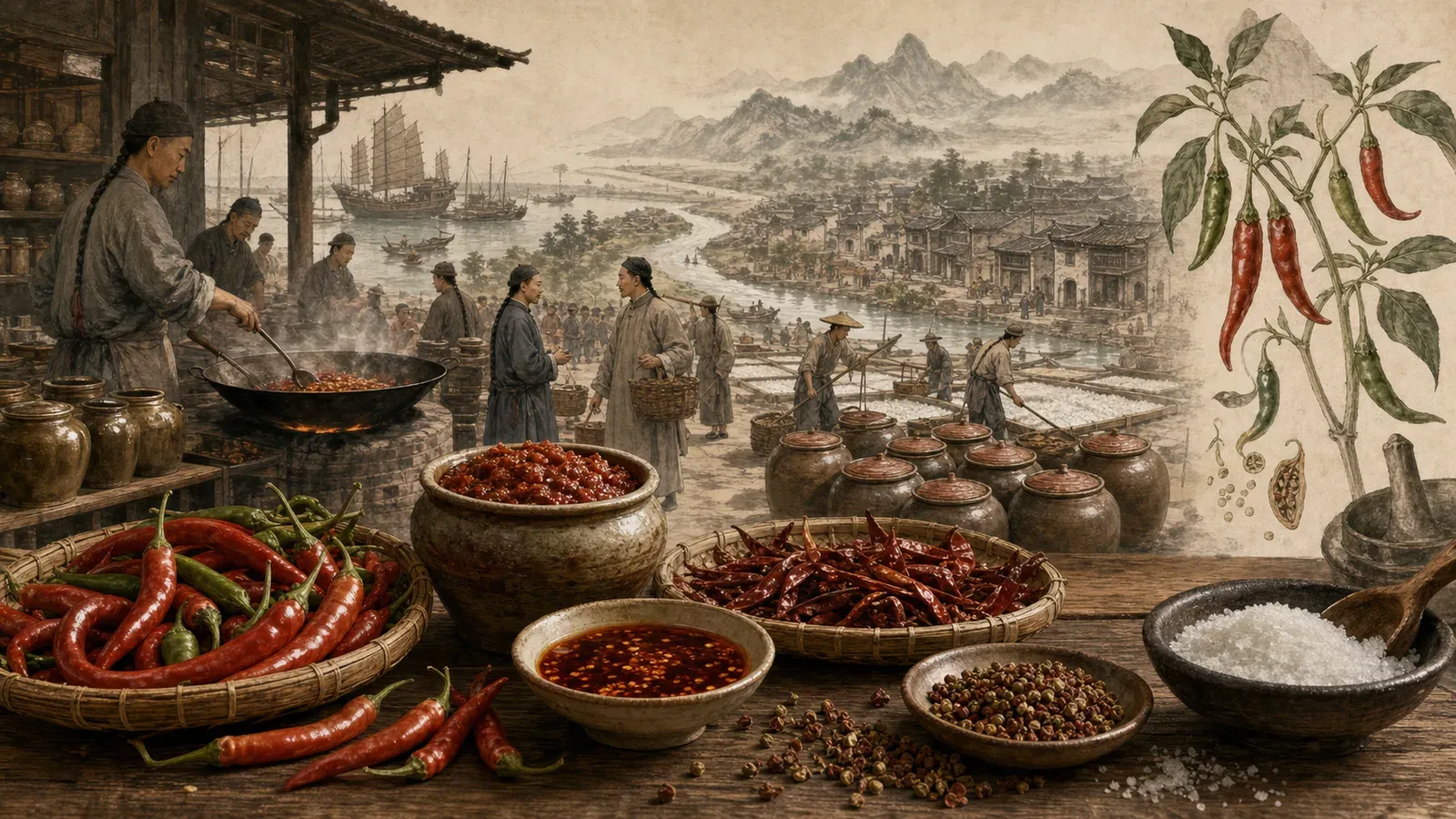
How Chili Peppers Spread Through Chinese Cooking
Preface: How a Foreign Fruit Entered the Chinese Kitchen
It is hard to speak about Chinese cooking today without speaking about chili. Many defining flavor profiles in Sichuan, Hunan, Guizhou, and Yunnan cuisine place chili at the center of the table. Yet in the long history of cultivated crops, chili arrived in China relatively late. It originated in the Americas, with domestication in the region around Mexico often traced back roughly six thousand years. After Columbus's voyages, chili entered Europe and then moved through Portuguese maritime trade as a cheap, portable spice that could stand in for pepper.[1]
China already had a long tradition of pungent seasoning before chili appeared. Ginger, scallion, mustard, black pepper, Sichuan pepper, and edible dogwood all helped remove gamy odors, build aroma, warm the body, and sharpen appetite. Chili changed Chinese cooking not only because it offered a direct sensation of heat, but also because it was easy to grow, inexpensive, easy to dry, and suitable for pickling and fermentation. Its spread depended on population movement, mountain settlement, salt routes, trade networks, and local seasoning systems that took shape across the Ming and Qing periods.[3][4]
 The story of chili in Chinese cooking connects overseas trade, mountain life, salt-route movement, and regional systems of seasoning.
1. From the Americas to Chinese Ports: Chili First Appears as "Foreign Pepper"
In early Chinese records, chili most often appears under the name fan jiao, or "foreign pepper." Scholars have long treated the 1591 publication of Zunsheng Bajian in the Wanli reign of the Ming dynasty as an important early Chinese reference to chili. More recent textual research has suggested that the fan jiao entry may have been supplemented or altered after the first printing, which means this piece of evidence needs to be read carefully within its version history.[2]
That detail matters. It reminds us that chili did not immediately become an everyday household seasoning when it first entered China. Early texts often placed it in the context of flowers, ornamental plants, garden curiosities, or substitutes for older pungent spices. Records from Hangzhou, Shaoxing, Shanghai, and nearby areas show that the southeastern coast and Jiangnan cities were among the first regions where chili became visible in writing.[2][3]
As for its routes into China, historical studies usually describe several paths, including the Zhejiang coast and surrounding maritime networks, a northeastern route, and a Taiwan-related route. The path that had the greatest influence on the later formation of China's major chili-eating regions appears to have entered through Zhejiang and nearby coastal areas before moving inland along the Yangtze and other networks.[3] Chili was first noticed, then selected, planted, cooked, and eventually stabilized as a regular seasoning.
2. Why Jiangnan Did Not Become China's Main Chili Heartland
The place where a crop first appears is not always the place where it most deeply transforms cuisine. Zhejiang and the nearby coast recorded chili relatively early, but the region today is generally associated with mild or lightly spicy cooking. By contrast, the middle and upper Yangtze region and the highlands of southwest China gradually became China's most prominent chili-eating areas after the Qing period.[3][4]
The difference came from living conditions. Jiangnan and the southeastern coast had developed commerce, dense waterways, and relatively abundant ingredients. Sugar, soy sauce, vinegar, rice wine, seafood, freshwater fish, and a wide range of vegetables already shaped everyday seasoning. Chili could be admired, planted experimentally, or used occasionally as a pungent substitute, but the region had less pressure to let it reorganize the whole structure of the meal.[3]
The middle and upper Yangtze and the southwest mountains were different. Hills, damp cold, difficult transport, and higher costs of moving goods gave pungent ingredients a more practical role. Modern research on the geography of chili consumption in China has also found correlations between strong chili preference and rainfall days, humidity, and sunshine. Hunan, Sichuan, Chongqing, Guizhou, and Yunnan all fall within China's strongest chili-eating zones.[4]
3. From Flowerpot to Table: Salt Shortage, Mountain Life, and Coarse Grains
Chili first found a firm place in cooking through the practical needs of ordinary life. In his study of local gazetteers, Yu Weijie notes that the 1722 Sizhou Prefecture Gazetteer from Guizhou contains clues about hai jiao, or chili, being used with meals and even in place of salt. After the Qianlong period, records of chili consumption became increasingly common in Guizhou, Hunan, Sichuan, Yunnan, and neighboring areas.[3]
"Replacing salt" should not be understood in a nutritional sense. Chili cannot replace the bodily need for salt. The point is that its sharp aroma and heat could make coarse food more appetizing and relieve the monotony of grains, beans, and plain vegetables. In places such as Guizhou, where mountains were high and salt transport was costly, poorer households had reason to rely on chili as an inexpensive, accessible companion to meals.[3]
From the late Ming and Qing onward, other American high-yield crops such as maize, sweet potato, and potato entered China's mountain regions. They expanded the amount of land that could be cultivated and drew more people into hilly and upland areas. Chili fit the same environment. It could grow in small plots, bear fruit over a long picking season, and be eaten fresh, dried, salted, or fermented. Alongside coarse-grain rice, pickled vegetables, beans, and cooking oil, it gradually moved from an exotic garden fruit to a stable seasoning and vegetable on poor households' tables.[3]
4. Migration and Trade Routes: Heat Travels with People
Chili also needed people to carry it. Large-scale migrations in the Ming and Qing periods, including movements from Jiangxi into Huguang and from Huguang into Sichuan, reshaped the population of the middle and upper Yangtze and the Sichuan Basin. Yu Weijie's research notes that Hunan formed chili-eating habits relatively early. The 1684 Baoqing Prefecture Gazetteer and Shaoyang County Gazetteer already contain chili records in Hunan, while an early Sichuan record appears in the 1749 Dayi County Gazetteer, more than sixty years later.[3]
Migrants carried seeds, but they also carried ways of handling food. Chili could be dried for travel, chopped and salted, fermented with beans, or placed in a pickle jar. When a family settled in a new place, small habits at the table often survived most easily: a dish of chopped chili, a jar of pickled chili, a spoonful of chili paste. Over time, those habits influenced neighbors, markets, and small restaurants.
Trade routes mattered just as much. Boatmen, porters, salt merchants, relay stations, guild halls, and town eateries helped chili move from household seasoning into public dining. Goods and people moving along rivers brought hot flavors into more places. Local cooks then adapted chili to local ingredients, oils, salts, acids, aromas, and wok techniques. For that reason, chili rarely spread as a single fixed taste. It traveled together with regional salt, oil, sourness, Sichuan pepper, bean paste, and the breath of the wok.
5. Condiments Turn Chili into Cuisine
For an ingredient to become part of a cuisine's foundation, fresh fruit alone is not enough. Fresh chili is seasonal, while cooking needs year-round stability. Dried chili, chili powder, chili oil, pickled chili, fermented chopped chili, and broad-bean chili paste turned chili into a storage-friendly, transportable, and repeatable seasoning system.
Pixian doubanjiang is one of the clearest examples from Sichuan. According to the Digital Museum of Chinese Intangible Cultural Heritage, Pixian doubanjiang is made primarily from broad beans, chili, and salt. The Shuntianhao sauce workshop was already active in 1803, and in 1853 Chen Shouxin opened the Yifenghe workshop and summarized the traditional method with the principles of sunning, covering, turning, and exposing. In 2008, the traditional craft of Pixian doubanjiang was listed as part of China's second batch of national intangible cultural heritage items.[5]
Doubanjiang moved chili from a source of heat into a source of layered savoriness. The pungency of chili, the fermented aroma of broad beans, the penetrating force of salt, and the ripening effect of sun by day and dew by night gave Sichuan cooking a stable base note. Pickled chili brings sour heat and freshness, dried chili brings roasted aroma and lingering force, Sichuan pepper brings numbing brightness, and rapeseed oil carries fragrance. At this point, chili was no longer only a sensation on the tongue. It had entered the structure of seasoning itself.
6. Salt-Industry Cuisine: How Chili Became Local in Zigong
Zigong Salt-Industry cuisine formed around well-salt production, an immigrant city culture, and the labor of the salt fields. Materials from Sichuan Provincial Gazetteer sources describe Zigong Salt-Industry cuisine as evolving from salt-field cooking, marked by thick flavor, deep aroma, fresh heat, and a social background shaped by salt wealth, urban diversity, and incoming migrants.[6]
In Zigong, chili first met the base flavor of well salt. Salt sharpens savoriness and gives chili something to hold on to. The second layer was labor. Salt workers performed exhausting physical work, and their meals needed to be filling, appetite-opening, and able to cut through plainness. Pungent flavors were therefore well suited to daily salt-worker food. Yu Weijie also notes differences in chili intensity between salt-worker dishes and the food of salt-well owners, a reminder that chili did not spread evenly through local society. Its distribution was connected to labor, class, and the function of the meal.[3]
The third layer was Zigong home cooking's fondness for fresh chili and young ginger. Sichuan Provincial Gazetteer materials on Zigong home-style Salt-Industry dishes note the frequent use of fresh chili and young ginger, with many forms of heat: chili paste heat, dried-chili heat, pickled-chili heat, fresh heat, green-and-red chili with young ginger, and sour heat. Dishes such as Fresh Pot Rabbit, quick-fried chicken, and quick-fried duck all depend on this vocabulary of fresh chili and young ginger.[7]
This is what makes Zigong heat different from a simple idea of "dry spiciness." It often layers the green aroma of fresh chili, the sharp warmth of young ginger, the sour fragrance of pickled chili, the fermented depth of doubanjiang, and the numbing lift of Sichuan pepper, then fixes those aromas quickly through techniques such as quick pan-frying, dry-braising, brief boiling, and water-boiling.[6][7] For local artisans like us, understanding how chili became local in Zigong matters more than chasing heat for its own sake. The fresh heat of Salt-Industry cuisine depends on salt, chili, ginger, oil, fire, and the condition of the ingredient all working together.
7. From Regional Taste to Everyday National Flavor
In the modern period, chili completed its shift from regional reliance to nationwide supply. A review published in Frontiers in Nutrition reports that China's chili planting area reached 21,474 square kilometers in 2019, exceeding the planted area of Chinese cabbage and tomato and making chili one of the country's largest vegetable crops by area. Total production exceeded 64 million tons that year. On the consumption side, Hunan and Sichuan ranked near the top by annual volume, followed by Hubei, Jiangxi, Guizhou, Chongqing, Yunnan, and other regions.[4]
Modern logistics allow fresh chili to move across seasons. Industrial fermentation has made doubanjiang, chopped chili, pickled chili, and chili oil more stable and widely available. The restaurant industry has carried the regional flavors of Sichuan, Hunan, Guizhou, and Yunnan into cities across the country. Today, the chili many people taste is rarely the raw flavor of one fruit. More often, it is the result of a whole system of condiments, cooking methods, and regional memory.
Conclusion: From Foreign Crop to Local Flavor
Chili's spread through Chinese cooking followed a long path. It moved from the Americas into global trade, appeared in Ming and Qing texts as fan jiao, became known along the coast, and then found deeper need in the middle and upper Yangtze and the mountains of southwest China. It traveled with migrants, salt routes, trade routes, and town eateries, and was eventually stabilized by doubanjiang, pickled chili, dried chili, fresh chili, and chili oil into transmissible flavor systems.
This history helps explain Salt-Industry cuisine more clearly. The heat in Zigong cooking is tied to well salt, salt workers, guild halls, home kitchens, and the timing of fire in southern Sichuan kitchens. Chili came from far away. Its transformation into a Chinese flavor happened slowly, one table at a time.
References
- Smithsonian Magazine: How Plants from the Americas Changed the World
- The Paper: The Story of Crops: Who First Recorded Chili in China? A Study of the "Fan Jiao" Entry in Gao Lian's Zunsheng Bajian
- Institute of Chinese Agricultural History, South China Agricultural University: Yu Weijie, Unintended Spread: On the Selective Diffusion of Chili in China
- Frontiers in Nutrition: Geographical and Ecological Differences in Chili Cultivation and Consumption in China
- Digital Museum of Chinese Intangible Cultural Heritage: Traditional Douban-Making Craft: Pixian Doubanjiang
- Sichuan Provincial Gazetteer: Why Zigong Salt-Industry Cuisine Stands Apart
- Sichuan Provincial Gazetteer: Home-Style Dishes in Zigong Salt-Industry Cuisine