

From Salt Wells to the Table: The Zigong Flavor Left by Salt Workers
Preface: A City's Flavor Often Begins in Labor
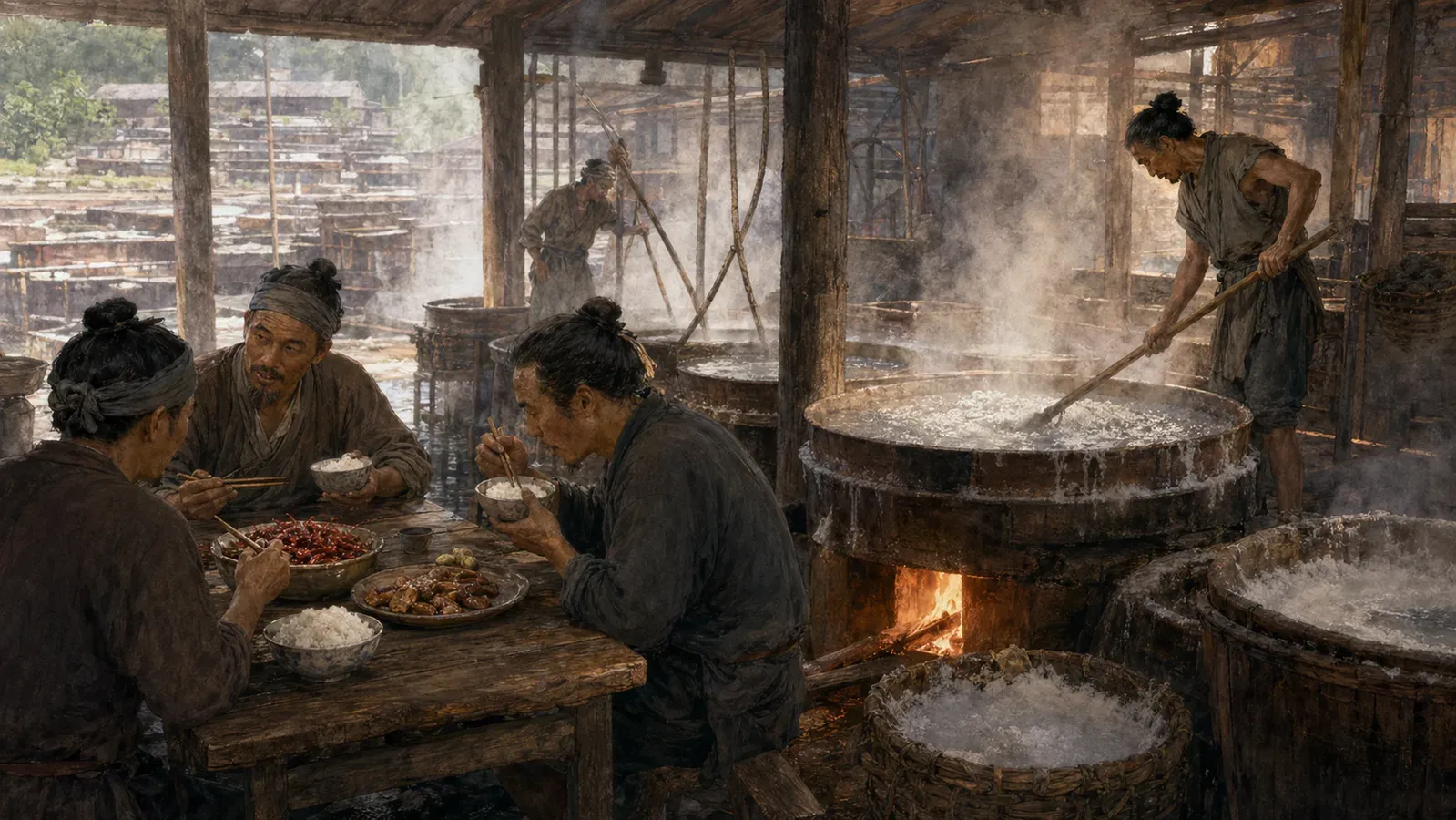
Zigong's flavor cannot be separated from work beside the salt wells. Derrick frames rose high, brine was drawn up, furnace fires glowed red, and steam drifted slowly through beams and roof tiles.[5] The days organized around well-salt production may seem distant now, but they remain in the heat control, salty savoriness, ginger-chili aroma, and table habits of Zigong Salt-Industry cuisine.[8]
Labor shaped the city, and it also shaped appetite. Salt workers faced damp well sites, burning stoves, heavy tools, and long transport. Such a life needed meals that could settle the body: rice had to be hot, dishes had to wake the palate, and flavors had to feel solid enough to send a person back to the well mouth and furnace.
 Salt-field fires, steam, and meals brought labor and flavor into the same space.
1. The Labor Foundation of a Salt City
Zigong rose because of salt and became known because of salt.[2][3][6] Sichuan Provincial Gazetteer materials state that the name "Zigong" comes from Ziliujing and Gongjing, two places that became market towns because of wells and became a city because of salt. From the late Tongzhi reign to the early Guangxu reign, the Furong salt field produced nearly 200,000 tons of salt, more than half of Sichuan's output.[2] Salt wells, stove rooms, salt warehouses, docks, and trade roads together formed the basic framework of the salt-industry city.[1][2]
The city's prosperity was carried by workers, and it became a system of daily division and coordination. Some guarded wells, some repaired them, some drew brine, some boiled salt, and some moved it. Every step that brought well salt from underground into human life carried strength, judgment, and patience.
2. Skill and Hardship Inside the Trades
Zigong Net's account of salt-worker history notes that, over Zigong's long salt-industry development, a large, skilled, and carefully divided salt-worker workforce gradually formed.[1] Workers passed skills down through generations and created a complete set of well-salt production techniques, opening more than 13,000 brine and natural-gas wells over time.[1]
The general term "salt worker" appeared relatively late.[1] In early well-salt production, farmers often worked part-time in salt operations, and penal labor was also used.[1] As division of labor became more detailed, trades such as mountain craftsmen, pounder workers, bamboo-strip repairers, roller workers, cattle handlers, brine carriers, stove sitters, and salt boilers appeared.[1] By the Tongzhi and Guangxu periods of the Qing dynasty, water carriers, salt-boat workers, salt porters, salt craftsmen, mountain craftsmen, and stove workers made up a large labor network in Zigong's salt fields.[1]
These names carry the feel of the worksite. Zigong Net also states that, based on historical estimates, direct and indirect salt workers, including year-round and temporary laborers, numbered around 200,000 in the Zigong salt field in the early Guangxu period. In the modern salt field, production was divided into well rooms, cart rooms, and stove rooms, with complex technical divisions inside each department.[1] Drilling required strength and patience, drawing brine required technique and order, boiling salt required long fire-watching, and transporting salt required foot strength and road knowledge.[1] Salt-worker skill matured through repeated movement, and salt-field order stabilized among these trades.
The large salt-worker population also formed its own social life. In the early Republican period, production workers gradually formed guild-like groups including mountain-craftsman groups, machine-and-cart groups, water-cart groups, cattle-handler groups, salt-transfer groups, and salt-bundling groups. Salt boilers worshipped Yandi, well drillers worshipped the Four Sages, and boatmen and trackers prayed for safety on waterways.[1] Teahouses, work songs, temple fairs, and stages formed everyday spaces beyond labor.[1] Salt workers' appetite, temperament, and table memories were slowly shaped in that city life.
3. Labor Wisdom Inside Well-Salt Technology
The derrick, or tianche, is one of the most representative symbols of well-salt culture.[5] It drew brine from deep underground and made the complexity of well-site labor visible: wooden structures, ropes, pulleys, bamboo tubes, animal power, and human labor had to work together before brine could keep leaving deep wells.[5]
People's Daily coverage of Zigong salt-industry archives notes that the archives contain more than 38,000 volumes and record several historical achievements in well-salt development, including Shenhai Well, the world's first salt well deeper than one thousand meters, salt-well drilling techniques, and the Dade Well derrick.[7] Such technical achievements came from long practice, observation, trial, and transmission.
Shenhai Well is a concentrated witness to this technical tradition. Zigong UNESCO Global Geopark materials state that Shenhai Well was completed in the fifteenth year of the Daoguang reign, reached a depth of 1001.42 meters, and included a pounder house, large cart house, and stove room, with equipment such as a pounder frame, derrick, and large cart.[4] Labor had a concrete form here. It lived in the weight of drill bits, the wear on ropes and bamboo tubes, and the judgment of fire and brine concentration.[1][4] Each mature operation carried earlier experience to the next well, the next furnace of salt, and also to the meal beside the stove.
4. The Salt-Worker Table: Flavor Order After Labor
The intensity of salt-worker labor directly changed the standard for food. A meal had to fill the body, open the appetite, and quickly bring a tired worker back to alertness. In this daily setting, Zigong cooking developed a fresh, spicy, thick, rice-friendly character.[1][8]
That flavor order has clear sources in life. Well salt supplied the base, ginger and garlic dispersed unwanted odors, chili opened the appetite, Sichuan pepper added a clear tactile brightness, pickles and vinegar supplied acidity, and rapeseed oil tied aromatics and ingredients together.[8] Small-pan frying, quick frying, dry-frying, flash frying, and water-boiling all suit the need to force aroma out quickly, making meat, offal, tofu pudding, and vegetables clean and direct.[8]
Many Salt-Industry dish names also carry the shadow of labor. Water-Boiled Beef, Cold Eat Rabbit, small-fried rabbit, and dry-fried dishes are vivid at the first bite and solid with rice. They suit the body's needs after hard work.[8] They serve banquets, but they also serve ordinary meals.
5. How Labor Settled into Local Flavor
Local flavor usually takes a long time to form. The fresh heat, thickness, and rice-worthiness of Zigong Salt-Industry cuisine came from repeated selection in salt-industry life.[1][8] It adapted to workers' bodies and also to the salt city's markets, guild-hall banquets, and family tables.[8]
What a city eats, how it eats, and why it prefers a certain flavor are often tied to local labor, industry, and daily rhythm. The salt-worker table is one way to understand Zigong. It shows flavor rooted deep in life, shaped by sweat, heat, time, and appetite.
Today, a bite of Cold Eat Rabbit, a bowl of rice, or a plate of ginger-chili stir-fry can still call up the trades beside salt wells, the people who watched fires in stove rooms, and the porters on salt roads. The intimacy of Zigong flavor lies here: it gathers a broad salt-industry history into an ordinary table.
Conclusion: Labor Left the City's Base Flavor
The history of Zigong well-salt civilization shows that labor leaves tools, archives, buildings, and techniques, and it also leaves flavor.[3][6][7] The people who worked between wells, stove rooms, and salt roads may not all have left names, but together they left the base flavor of a city.
Salt workers brought well salt from underground into the world. Salt-Industry cuisine brought the experience of labor to the table. Zigong's fresh, spicy, rich aroma therefore has a reliable origin: the depth of the well mouth, the heat of the furnace, and the practical substance of ordinary meals.
References
- Zigong Net: Zigong Salt Workers Fostered Well-Salt Culture on the Historical Stage
- Sichuan Provincial Gazetteer: The Origin of Zigong
- Sichuan Cultural Relics Bureau: Inside Zigong Salt Industry History Museum: Inheriting Two Thousand Years of Well-Salt Civilization
- Zigong UNESCO Global Geopark: Shenhai Well Salt-Industry Site
- China News Service: Zigong Well-Salt Production Has More Than Two Thousand Years of History
- China News Service: Zigong Salt Industry History Museum: Inheriting Two Thousand Years of Well-Salt Civilization
- People's Daily Online: More Than 30,000 Volumes of Salt-Industry Archives Witness Zigong's Development as a Thousand-Year Salt Capital
- Sichuan Provincial Gazetteer: Why Zigong Salt-Industry Cuisine Stands Apart