

How Provincial Guild Halls Reshaped Salt-Industry Cuisine
Preface: Home Accents and Wok Aroma Inside Guild Halls
Zigong Salt-Industry cuisine is often remembered for fresh heat, thick flavor, and dishes that make rice taste better.[2][5] Follow that flavor backward and one finds salt wells, salt merchants, salt workers, and also a line of guild halls.[1] These halls were originally places where outside merchant groups maintained hometown ties, discussed business, held rituals, and hosted fellow natives. After entering the salt city of Zigong, they gradually became places where flavors met.[1][3]
Salt transport brought wealth, and it also brought people. Migrants and merchants from Shaanxi, Shanxi, Guizhou, Jiangxi, Anhui, Hubei, Hunan, Guangxi, Guangdong, and other places entered the Furong salt district, bringing accents, beliefs, banquet habits, and memories of seasoning.[1][2] The varied face of Zigong cooking grew out of this long coexistence.[2][6]
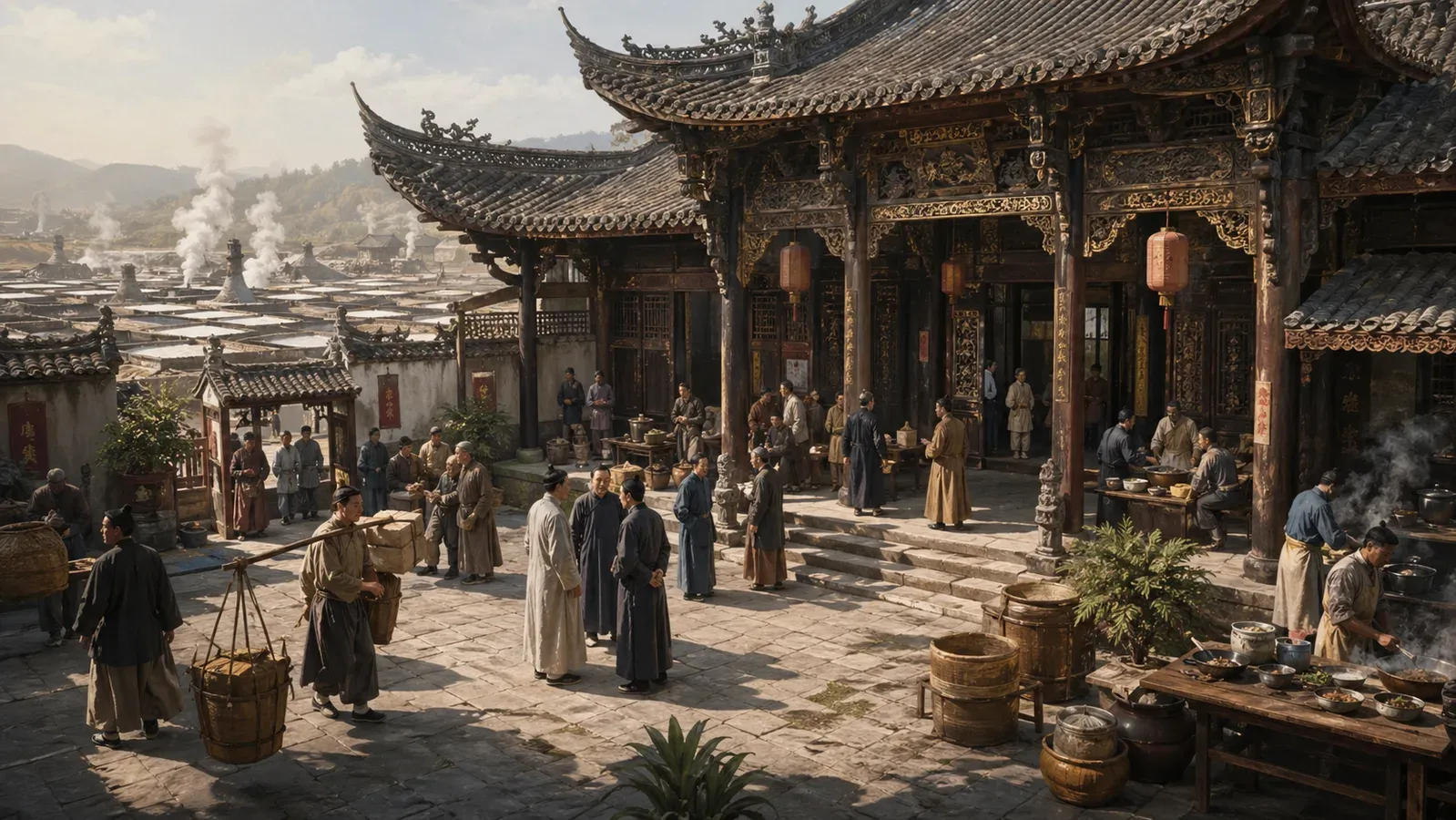
 Guild halls placed salt trade, outside merchant groups, and local life inside the same civic space.
1. Guild Halls First Created Urban Order
Local gazetteer materials record that Zigong has nearly two thousand years of well-salt production history. By the middle Ming period, early forms of capitalist production had appeared, and by the nineteenth century the area had developed one of China's large-scale handicraft production systems.[1] The salt industry drew dense flows of people, and well sites, salt firms, docks, markets, and guild halls together formed the framework of urban life.[1][2]
Among the preserved or documented salt-industry sites in Zigong, guild-hall and temple sites include Xiqin Guild Hall, Wangye Temple, Huanhou Palace, Yandi Palace, Nanhua Palace, and Guizhou Temple.[1] They stood in areas dense with salt production and trade and served ritual, mutual-aid, business, and reception functions.[1][3] For outside merchant groups, a guild hall could feel like a foothold of home. For the city, guild halls organized people from different regions into one salt-industry order.
Food entered everyday life through that order. Business meetings required banquets, festivals required offerings, merchant travel required hospitality, and cooks and ingredients moved with these needs. The guild-hall table therefore had a natural openness: local well salt supplied the base flavor, outside tastes brought variation, and banquet etiquette required dishes to be complete and presentable.
2. Xiqin Guild Hall: A Salt Network Inside One Building
Xiqin Guild Hall is a key entry point for understanding Zigong guild-hall culture. Materials from the Sichuan Cultural Relics Bureau state that it was built by Shaanxi merchants and is a well-preserved, large-scale salt-industry guild-hall building in Zigong.[3] In the tenth year of the Yongzheng reign, the Shaanxi salt-merchant guild organization Xiqin Dahui bought land for a temple; construction began in the first year of Qianlong and was completed in the seventeenth year of Qianlong. It was commonly known as the Shaanxi Temple.[3]
Zigong UNESCO Global Geopark describes Xiqin Guild Hall as a building jointly funded by Shaanxi merchants who came to the Ziliujing area to operate in the salt trade. Its architecture combines courtly and folk styles.[4] Today, the Zigong Salt Industry History Museum is housed there, with collections that include well-salt contracts, archives, drilling and well-repair tools, and other salt-industry artifacts.[4]
This building shows two things. First, Zigong's salt industry attracted long-distance merchant groups with the wealth and organization needed to build public spaces. Second, behind the guild hall stood a network of wells, account books, contracts, inns, kitchens, and banquets. Local flavor circulated through that network, and dishes became more refined through repeated reception and entertainment.
3. Guild-Hall Cooking: Hometown Flavor Enters Salt Flavor
Salt-Industry cuisine is often divided into merchant cuisine, worker cuisine, guild-hall cuisine, and other branches.[2] Merchant cuisine carried the refined taste of wealthy households; worker cuisine stayed close to labor; guild-hall cuisine preserved the traces of an immigrant city.[2]
The key to guild-hall cooking is the entry of hometown flavor into salt flavor. Outside merchants arriving in Zigong first wanted familiar tastes. Northerners knew wheat foods and sauce aromas; travelers from Huguang brought sour heat and cured foods; merchants from Guangdong, Fujian, Jiangxi, and nearby regions brought memories of freshness, soups, and precise heat control. After these tastes entered the salt city, they were adjusted by well salt, rapeseed oil, doubanjiang, Sichuan pepper, ginger, garlic, pickles, and local ingredients.
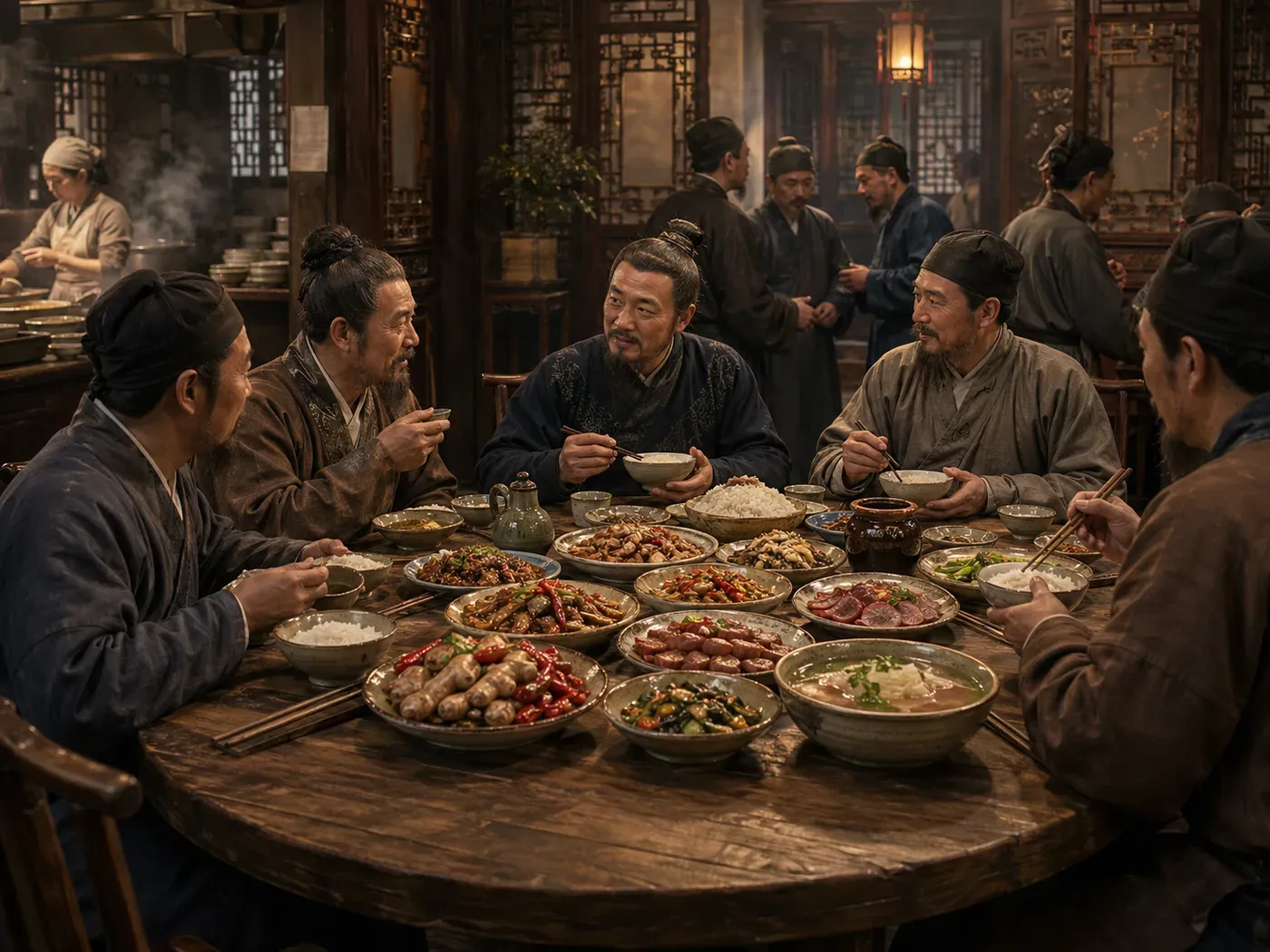 Merchant gatherings, banquet hospitality, and local ingredients gave guild-hall cooking its blended character.
An article on Sichuan Provincial Gazetteer notes that Zigong was a typical immigrant city. Incoming migrants, a developed salt industry, and finance-driven commerce allowed food consumption at different social levels and food cultures from different regions to mix, gradually forming a salt-field cuisine system.[2] This process happened over a long daily rhythm. Guild-hall banquets, business-house hospitality, the movement of well-known cooks, family kitchens, and market restaurants all took part.[2][6]
4. Guild Halls Changed the Scale of Salt-Industry Cuisine
The influence of guild halls first appeared in the scale of dishes. Worker cuisine emphasized directness and rice-worthiness, while guild-hall banquets also required dignity, structure, and hospitality. A meal needed cold and hot dishes, meat and vegetables, soups and snacks. It had to satisfy fellow natives seeking familiarity and leave outside guests with a sense of the salt city's abundance.
This banquet demand encouraged Salt-Industry cuisine to value careful materials, selection, and preparation.[5] Zigong Net notes that Salt-Industry cuisine pays close attention to heat control, excels at small-pan frying, quick frying, dry-frying, and dry-braising, and includes cold dishes, stir-fries, braises, steamed dishes, sweets, soups, and other series.[5] Guild-hall tables placed these techniques inside a reception order, moving dishes from home kitchens and work sheds toward banquets and restaurants.
Guild halls also changed the scale of seasoning. Zigong cooking is skilled with ginger and chili and is known for thick, aromatic flavor. After outside tastes entered, sweetness, acidity, sauce aroma, soup freshness, cured foods, and wheat snacks gave the local heavy flavor more layers. Salt-Industry cuisine therefore developed a broad structure: the first bite could be fresh and spicy, or deep and mellow; one table could include high-heat small stir-fries, slow braises, water-boiled dishes, huo du preparations, cold-eat dishes, and dry-fried foods.
5. From Guild Halls to City Flavor
The power of guild halls eventually entered the flavor of the whole city. From the late Qing and early Republican period through the 1940s, Zigong's restaurant market was active, and famous restaurants, chefs, and dishes continued to appear.[2][6] Sichuan Provincial Gazetteer materials state that dishes such as Fire-Edge Beef, Water-Boiled Beef, Niufu Baked Pork Knuckle, and Cold Eat Rabbit became popular during this period, while restaurants including Tiandeyuan, Lumingchun, Jinguyuan, Yiyuan, and Haoyuan emerged.[2] During the War of Resistance, Zigong had more than five hundred restaurants, serving Sichuan, Beijing, Shandong, Guangdong, Jiangsu, and other regional cuisines.[2]
These facts show that guild-hall culture left Zigong with an urban cooking capacity. Zigong cooks became familiar with outside flavors and skilled at placing them inside local wok aroma. They understood banquets without abandoning home cooking; they valued technique while preserving the fresh, spicy, rice-friendly core.
Today, guild-hall cuisine can be understood as the blended layer of Salt-Industry cuisine. It gave Zigong cooking wide sources and gave Salt-Industry cuisine a distinct openness within the Sichuan culinary map. Well salt fixed the base flavor, guild halls brought tastes from many regions, and city life simmered them into a local style that could be passed on.
Conclusion: The Taste Reception Room of a Salt City
A guild hall is a building, but it is also a network of people. It holds homesickness and serves as the reception room of a commercial city. It brought travelers from many regions to Zigong and left their taste memories among the salt city's stoves.
Understanding the influence of guild halls makes another origin of Zigong cuisine visible. Beyond fresh heat and thick flavor, there were migration, exchange, banquets, negotiation, and mutual adjustment. The genes of Zigong Salt-Industry cuisine are therefore complex and steady: half from the depth of well salt, half from the tables of people who came from elsewhere.
References
- Sichuan Provincial Gazetteer: Zigong City Local Conditions
- Sichuan Provincial Gazetteer: Why Zigong Salt-Industry Cuisine Stands Apart
- Sichuan Cultural Relics Bureau: Xiqin Guild Hall, Zigong Municipal People's Government
- Zigong UNESCO Global Geopark: Zigong Salt Industry History Museum
- Zigong Net: Zigong Salt-Industry Cuisine Moves Toward Brilliance Through Innovation
- China.com.cn Photo China: Zigong Salt-Industry Cuisine in Sichuan