

Salt Workers' Wisdom: From Heavy Labor to Bold Rice-Friendly Dishes
Preface: Labor History Inside a Bold Flavor
When people discuss Zigong Salt-Industry cuisine, many first think of salt merchants' display, ornate guild halls, and famous chefs. Yet the base of this flavor system was also held up by people who stood for years between derricks, stove rooms, salt warehouses, and docks: salt workers.[1][2]
Salt-worker cuisine is often summarized as strong, spicy, and good with rice.[3] That description is accurate, but incomplete. Behind it were the long history of well-salt production, the need for calories and salt after heavy physical labor, and the cooking order that ordinary families developed with limited ingredients.[1][4] In other words, the "boldness" of salt-worker food was first a demand that life placed on food.
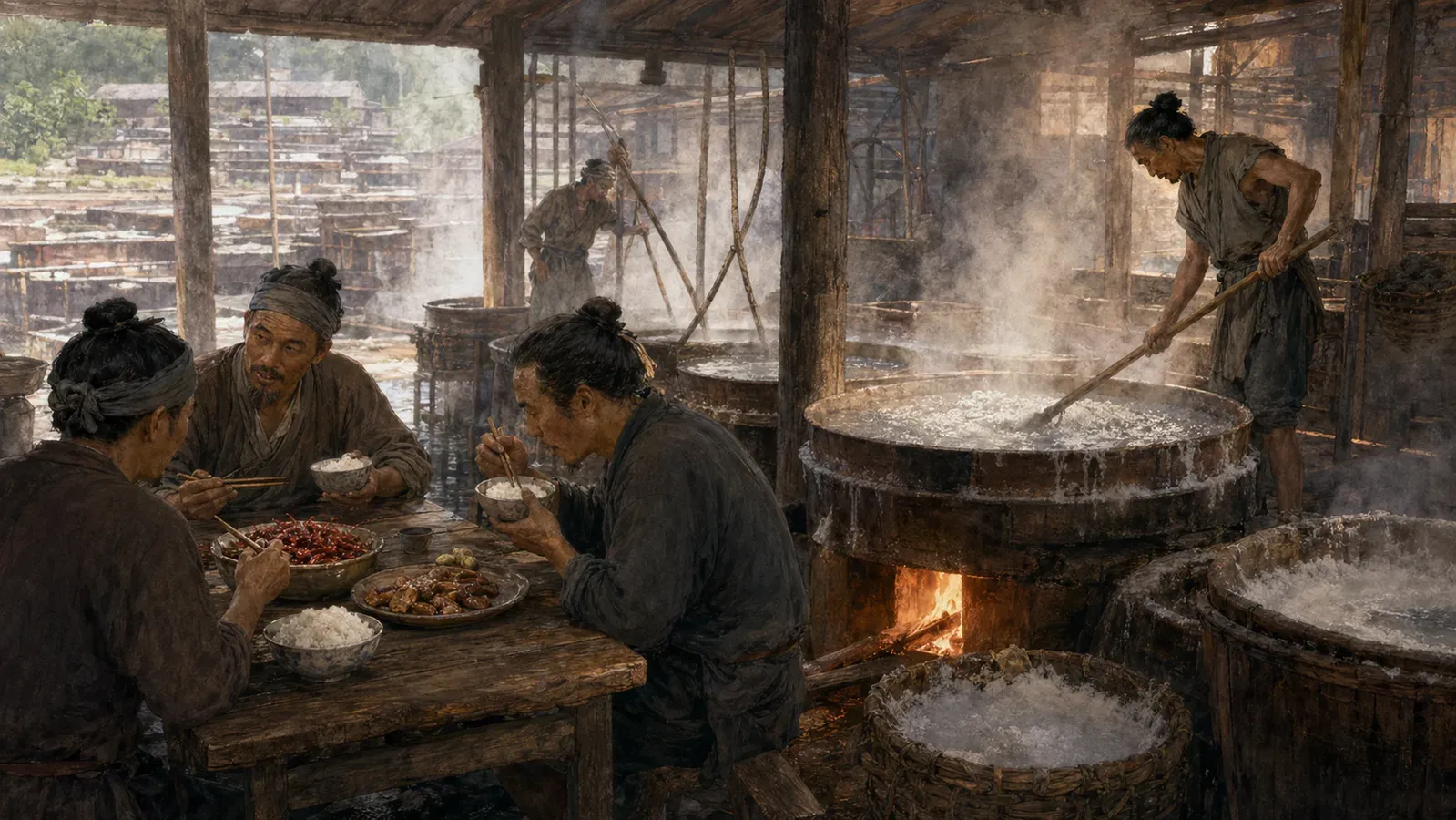
 Heat, furnace fire, and meals in the salt field shaped the base color of salt-worker cuisine.
1. Salt-Field Labor: Bodily Experience from Well Mouth to Furnace
Zigong well-salt production can be traced back to the reign of Emperor Zhang of the Eastern Han dynasty.[1] Local gazetteer materials record that the Zigong area has nearly two thousand years of well-salt production history and has opened more than 13,000 salt wells. When Lu You entered Rongzhou in the Song dynasty, he wrote of drawing brine with long tubes and boiling it like snow and frost, recording the local scene of brine extraction and salt boiling.[1]
Well salt came from a long and heavy production process. Drilling, drawing brine, moving brine, boiling salt, and transporting salt each depended on the close cooperation of human strength, animal power, and fire.[1][2] A salt worker's day involved damp well sites, burning furnace heat, heavy implements, and repeated labor over long hours.[1] The more the body was consumed, the more food needed to offer immediate satisfaction: it had to open the appetite, match rice, and restore a person to a clear, solid state after sweat.
This explains why salt-worker food favored clear ginger-chili aroma, enough oil fragrance, and concentrated sauce. A tired body needed flavor that took effect quickly, and salt-worker cuisine formed gradually in that daily need.
2. Bold and Rice-Friendly: The Plain Logic of Salt-Worker Food
Salt-Industry cuisine is often divided into merchant cuisine, worker cuisine, guild-hall cuisine, and other branches.[3] Merchant cuisine values refinement and expresses wealthy taste; guild-hall cuisine carries the mixed character of an immigrant city; worker cuisine grows beside the stove and the table, emphasizing direct pleasure, fullness after eating, and efficient technique.[3]
In salt-field life, one dish often had two tasks: wake the appetite and make rice taste good. Salt-worker food therefore developed several stable tendencies.
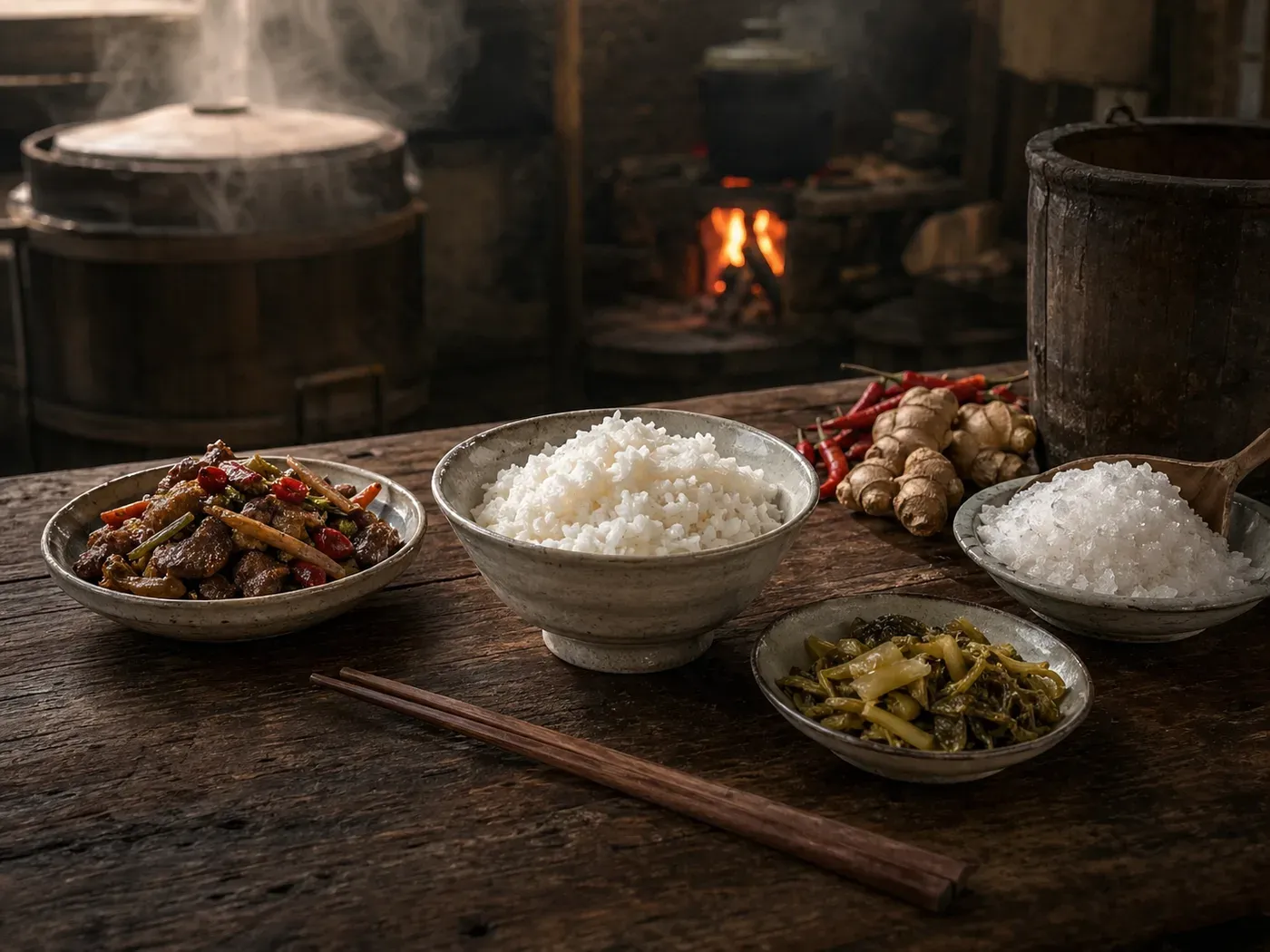 Rice, ginger, chili, well salt, and chewy meat form the basic structure of a rice-friendly meal.
First is strong seasoning. Well salt provides the base flavor, while chili, Sichuan pepper, ginger, garlic, doubanjiang, pickles, and vinegar create layers. Salt gives structure, pungent aromatics wake the senses, and acidity cuts richness.
Second is strong heat control. Zigong cooking excels at small-pan frying, quick frying, dry-frying, dry-braising, water-boiling, and flash frying. These methods force aroma out in a short time and handle meat, offal, or vegetables cleanly.
Third is practicality. Salt-worker food has little need for elaborate ceremony. Between one wok and one spatula, the dish should be deeply fragrant, sharply spicy, and steadily salty-savory. Here, "good with rice" is the first standard selected by working life.
3. Beef, Rabbit, and Offcuts: Salt-Field Resources Enter the Table
Zigong's salt industry depended heavily on draft cattle for a long time. A Zigong Net account of Salt-Industry ingredients notes that since the mid-nineteenth century, the hundred-li salt field often kept nearly 30,000 draft cattle year-round. Sick, old, or retired cattle entered the food system, making beef an important ingredient in Salt-Industry cuisine.[5] From this perspective, Water-Boiled Beef, Fire-Edge Beef, Cold Eat Beef, and related dishes have a deep connection to the salt-field production structure.[5]
Salt-worker food is skilled at turning ingredients near the production site into reliable meals. Beef can be shredded and dry-fried or sliced thin and water-boiled; rabbit can be small-fried, cold-eaten, or cooked quickly in fresh-pot style; offal loses unwanted odor and gains fragrance through flash frying; vegetables lose excess moisture and develop charred aroma and sweetness through dry-frying.[3][4][5] The ingredient does not have to be expensive. Accurate handling matters more.
This wisdom is especially clear in the respect for scraps and offcuts. Salt-worker and ordinary household tables left little room for waste. Tendons, trimmings, blood curd, tofu pudding, seasonal vegetables, and pickles could all find a place in a bold seasoning system. Strong flavor helped ingredients with complicated texture or obvious odor make a dignified turn.
4. Home Cooking: The Everyday Vessel of Salt-Worker Wisdom
Salt-merchant banquets preserved the polished side of Salt-Industry cuisine, while home cooking preserved the daily texture of worker food.[3][4] A Sichuan Provincial Gazetteer repost titled "Home-Style Dishes in Zigong Salt-Industry Cuisine" states that Zigong home cooking uses local and seasonal ingredients, changes flexibly, is simple to operate, and has thick, mellow flavor.[4] This judgment is important: salt-worker food exists on restaurant menus, but it also hides on family chopping boards, in pickle jars, and in old iron woks.
Zigong home-style twice-cooked pork may use green chili, young ginger, scallion white, Chinese onion, dried cowpeas, cabbage, or even guokui flatbread as supporting ingredients. Water-Boiled Beef can change its vegetables with the season. Dry-fried green beans, dry-fried cowpeas, dry-fried bitter melon, dry-fried eel shreds, and small-fried rabbit all rely on the same plain rules: use what is available, get the heat right, and keep the flavor steady.[4]
This approach carries a daily beauty made from alternating slow fire and fierce heat. Ordinary things become vivid, and one meal can hold layers and memory. Many unforgettable flavors in Zigong cooking grew slowly from this kind of home experience.
5. From Worker Food to Salt-Industry Cuisine
The formation of a cuisine usually requires three forces: stable products, dense population, and enough time. Zigong had all three.[1][3] Well salt raised the city. The salt field drew workers, merchants, boatmen, porters, and migrants. Labor, trade, banquets, and family life crossed repeatedly until the city developed a clear flavor outline.[1][3]
Salt-worker food played the role of base flavor. It reminds us that the brilliance of Salt-Industry cuisine came not only from merchant wealth, but also from ordinary workers' serious demands of food. Rice had to satisfy, dishes had to wake the body, flavor had to have force, and it still needed a returning sweetness. These plain standards allowed Zigong food to enter banquets and return to the home table, to become a local symbol while retaining the reality of daily life.
Today, when we speak of Cold Eat Rabbit, Fresh Pot Rabbit, Water-Boiled Beef, and small-fried rabbit, we can still see the shadow of salt-worker food: heat control, ginger and chili, salty savoriness, and a lingering chew. They carry appetite, and they also carry a salt city’s ability to make hard days flavorful.
Conclusion: Turning Hard Labor into Good Flavor
Salt workers' wisdom came from long labor, careful household budgeting, respect for ingredients, and the seriousness of a hot meal.
To understand salt-worker cuisine is to approach the deeper texture of Zigong Salt-Industry cuisine. Its fresh and powerful style settled along the route from well mouth to furnace to table. It shows that durable local flavor often first settles the body, then settles memory.
References
- Sichuan Provincial Gazetteer: Zigong City Local Conditions
- Guangming Online: Seeking Salt-Capital Flavor: Zigong Well Salt and Salt-Industry Cuisine
- Sichuan Provincial Gazetteer: Why Zigong Salt-Industry Cuisine Stands Apart
- Sichuan Provincial Gazetteer: Home-Style Dishes in Zigong Salt-Industry Cuisine
- Zigong Net: Beef: A Leading Ingredient in Salt-Industry Cuisine