

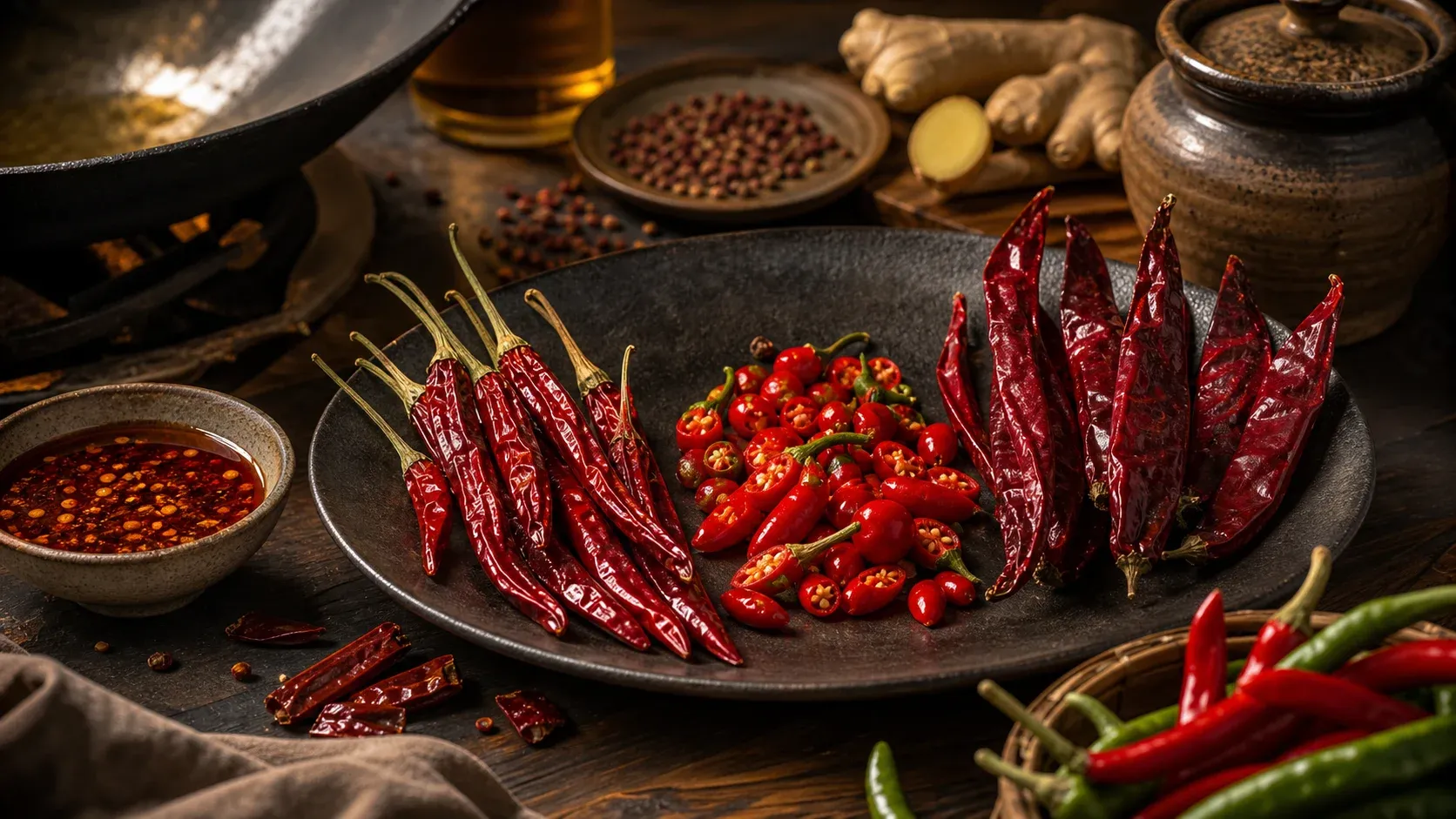
Common Chili Varieties in Sichuan Cuisine: Flavor Profiles of Erjingtiao, Xiaomila, and Chaotianjiao
Preface: Every Chili in Sichuan Cuisine Has Its Own Flavor
When discussing chilies in Sichuan cuisine, Erjingtiao, Xiaomila, and Chaotianjiao are often mentioned together. While they all provide heat, each brings something unique to the wok. Erjingtiao is frequently used in Doubanjiang (broad bean paste), chili oil, pickled peppers, and dried chili preparations, laying down a foundation of aroma, bright red color, and mild baseline heat. Xiaomila is mostly used in fresh pepper dishes, chopped chili preparations, dipping sauces, and tender ginger stir-fries, offering a sharp and direct spiciness. Chaotianjiao (Facing Heaven Pepper) usually appears in its dried form, leaving a lingering dry aroma and a powerful kick in dry-fried (ganbian), quick-fried (qiangchao), hot pot bases, and cold dishes (lengchi).
These differences stem from the chili varieties themselves, as well as how they are processed. The same chili will develop entirely different flavor profiles when used fresh, sun-dried, salted, fermented, ground into powder, or infused into oil. Research on the spiciness of Sichuan dishes published in Food Science indicates that the intensity of a dish's spiciness is not only related to the type and amount of chili and its derivatives used, but is also closely associated with processing methods, ingredient sizes, cooking temperatures, and other seasonings. [1] Therefore, the flavor profile of chili peppers in Sichuan cuisine depends not only on the intrinsic spiciness of the variety, but also on the form in which they are cut, the duration of heating, and how they interact and harmonize with oil, salt, ginger, garlic, and Sichuan peppercorns.
 Erjingtiao supports chili oil and baseline flavors, Xiaomila brightens fresh pepper and tender ginger dishes, while Chaotianjiao anchors dry aromas and lingering heat.
1. Erjingtiao: Aroma, Bright Red Color, and Baseline Flavor
Erjingtiao is one of the most representative chili varieties in Sichuan cuisine. The geographical indication data for Xichong Erjingtiao Chili summarizes its qualities as follows: the fresh red chili has a slender fruit, crisp and tender flesh, and moderate spiciness; the dried chili is bright red, thin-skinned with few seeds, and has a mellow aroma. [2] Today, these observations, originally drawn from kitchen experience, have even been quantified into specific agricultural standards such as fruit length, water content, and capsaicin levels. [3]
This stable quality, verified by official standards, is exactly what establishes its foundational role in Sichuan cuisine. Erjingtiao's strength lies in its outstanding aroma and its enduring, mellow flavor. It can be eaten fresh, but is also highly suitable for sun-drying, making sauces, Doubanjiang, and chili oil. When the fresh fruit goes into the wok, it offers a green bell pepper-like fragrance and a gentle heat; after ripening to red and being dried, its color easily infuses into oils, and its aroma can withstand prolonged release. Many Sichuan dishes require a baseline flavor capable of supporting the rich tastes of fermented sauces, oils, and meats, and Erjingtiao is perfectly suited for this position.
Research on chili oil also indirectly confirms Erjingtiao's status. A study on dry chili varieties and chili oil flavor, published in Food Science in 2025, used an electronic nose, gas chromatography-ion mobility spectrometry, and quantitative descriptive analysis to compare chili oils made from different dried chili varieties. The study concluded that chili oil made with Erjingtiao chilies exhibited outstanding aromatic properties, imparting a rich fragrance to the oil; meanwhile, Xiaomila provided a sustained spiciness characterized by a roasted chili aroma and high heat intensity. [4] The emphasis on Erjingtiao for chili oil, dipping sauces, and cold dish seasonings is directly related to its ability to persistently integrate its aroma into fats.
In Sichuan cooking, Erjingtiao has a very broad range of applications. Fresh Erjingtiao can be diced or cut into sections for explosive stir-frying (baochao) and braised dishes; dried ones can be snipped into sections to flavor hot oil, or ground into coarse powder to make chili oil. The aforementioned study on the spiciness of Sichuan dishes specifically analyzed fresh Erjingtiao: when added at the end of cooking, the dissolution of spicy compounds is limited; however, when thoroughly mixed with other ingredients and heated, its cellular structure breaks down, making it much easier for the spicy compounds to enter the edible parts of the dish. [1] This makes Erjingtiao a chili that truly tests a chef's mastery of heat control and timing.
2. Xiaomila: Direct Fresh Heat and the "Tender Ginger & Fresh Chili" Profile
The defining characteristic of Xiaomila is its fresh, sharp heat. It is small but juicy; once cut, its spiciness quickly permeates into oils, broths, and dipping sauces. Research on capsaicinoids in Xiaomila by the Journal of South China Agricultural University shows that capsaicin and dihydrocapsaicin can be synthesized in both the placenta and the pericarp (flesh), with their content significantly correlated with the tissue location and developmental stage—the highest concentration being found in the placenta. [5] This explains the distinct punch Xiaomila delivers upon consumption: once minced, crushed, or finely chopped, the capsaicinoids near the placenta are more readily released into juices, oils, and broths.
At the level of Sichuan dishes, the amount of Xiaomila used has a very direct relationship with the intensity of the heat. The Food Science study on grading the spiciness of Sichuan dishes pointed out that as the amount of fresh Xiaomila increases, the dish's spiciness progressively strengthens; additionally, the nature of the main ingredients affects flavor absorption—thinner, more porous ingredients will make the spiciness much more pronounced. [1] Xiaomila frequently appears in fresh chili-style dishes, dipping sauces, cold mixed dishes, and quick stir-fries. It delivers heat rapidly and gives the dish's initial aroma a bright, uplifting quality.
Zigong Yanbang cuisine is particularly adept at utilizing this style of fresh heat. Documents on Zigong home-style cooking, reprinted by the Sichuan Provincial Conditions Network, mention that Zigong cuisine excels in using fresh chilies and tender ginger. Fresh Pot Rabbit (Xianguo Tu) is a prime example of this successful combination; the same text also lists various spicy flavor profiles such as red chili with tender ginger, green and red chili with tender ginger, and fresh chili with pickled chili. Dishes like Fresh Pot Rabbit, Pan-seared Chicken (Xiaojian Ji), and Pan-seared Duck are all closely associated with the combination of green/red chilies and tender ginger. [6] In these dishes, Xiaomila is usually responsible for the initial stimulating bite, the tender ginger provides a crisp and fragrant pungency, while Sichuan peppercorns and hot oil push the fresh heat toward the back of the palate.
Besides being used fresh, Xiaomila is also commonly fermented. A study on the flavors of differently fermented Xiaomila used Headspace Solid-Phase Microextraction-Gas Chromatography-Mass Spectrometry (HS-SPME-GC-MS) non-targeted analysis to describe its aroma profile, noting that these findings provide a theoretical basis for evaluating the flavor quality of fermented Xiaomila products and for variety selection. [7] After fermentation, in addition to heat, Xiaomila develops tart aromas, ester fragrances, and a mellower, fermented tang. The Xiaomila found in pickled peppers (Paojiao), chopped salted chilies (Duojiao), and fermented chili pastes relies precisely on this transformation from sharp fresh heat to a sour-spicy profile.
3. Chaotianjiao: Concentrated Heat in the Dried Chili System
Chaotianjiao (Facing Heaven Pepper) most commonly appears in Sichuan cuisine in its dried form. In markets and kitchens, "Chaotianjiao" sometimes refers broadly to a category of chilies that grow pointing upward, are relatively small, and have a concentrated heat. It is often interchangeably used in trade with other dried chili varieties like Bullet Chili (Zidantou), Seven Star Chili (Qixingjiao), and Sky Full of Stars (Mantianxing). Different batches of Chaotianjiao can vary in size, aroma, spiciness, and heat tolerance during cooking.
From a culinary perspective, Chaotianjiao is primarily responsible for delivering dry aroma and a lingering afterburn. Drying reduces its water content, allowing hot oil to rapidly extract a toasted, nutty aroma and a pungent, stimulating heat. Research on chili oils made from different chili varieties indicates that oils made from varieties like Thread Chili (Xianjiao), Chaotianjiao, Erjingtiao, Qixingjiao, Sanyingjiao, and Tiandengjiao show significant differences in single-flavor intensity and overall flavor profile; the volatile compounds detected via SPME-GC-MS are primarily aldehydes, esters, alcohols, and alkenes, and the specific chili variety significantly affects the content of these volatile substances in the oil. [8]
When Chaotianjiao is used in dishes like Dry-fried Rabbit (Ganbian Tu), Dry-fried Shredded Beef, Spicy Crispy Chicken (Laziji), quick-fried vegetables, hot pot bases, and the "Cold Eat" (Lengchi) series, the first thing to be activated is its dry chili aroma. When the heat is just right, the dried chili brings a roasted fragrance and a sustained spiciness to the dish; if overcooked, bitterness will mask the aroma. Chaotianjiao is frequently used in combination with Erjingtiao: Erjingtiao provides the bright red color and aroma, Chaotianjiao supplies the intense heat and rear-palate stimulation, and Sichuan peppercorns spread out the numbing sensation.
In Zigong's "Cold Eat" dishes, this lingering dried chili aftertaste is especially crucial. The Zigong local history data from the Sichuan Provincial Conditions Network summarizes that Zigong Yanbang cuisine is characterized by its heavy use of chilies and ginger, generous seasoning, and rich, robust, and layered flavors. It particularly excels in water-boiling (Shuizhu) and live-braising (Huodu) techniques, with representative dishes including Cold Eat Rabbit (Lengchi Tu) and Fresh Pot Rabbit. [9] For dishes like Cold Eat Rabbit, which undergo stir-frying, seasoning, and cooling, the oils continue to carry the aromas of the dried chilies and Sichuan peppercorns, causing the spiciness to steadily radiate from the surface of the diced meat toward the back of the throat upon tasting.
4. Flavor Division Among the Three Chilies
| Variety | Primary Flavor | Common Forms | Culinary Role | Typical Applications |
|---|---|---|---|---|
| Erjingtiao | Distinct aroma, moderate heat, bright red when dried | Fresh, dried, chili powder, Doubanjiang, chili oil | Provides baseline flavor, color, oily aroma, and mild heat | Chili oil, Doubanjiang, Twice-cooked Pork, dry-frying, quick stir-fries |
| Xiaomila | Direct fresh heat, sharp initial sting | Fresh, chopped salted, pickled, fermented | Delivers initial heat, fresh chili aroma, and sour-spicy complexity | Fresh Pot Rabbit, Pan-seared Chicken, dipping sauces, cold mixed dishes |
| Chaotianjiao | Concentrated heat, pronounced dry aroma, strong lingering kick | Mostly dried, chili sections, chili powder | Elevates spiciness, dry roasted aroma, and rear-palate stimulation | Cold Eat Rabbit, Spicy Crispy Chicken, hot pot base, quick-fried dishes |
This table outlines the common kitchen division of labor, but for any specific batch of chilies, one must also consider the cultivar, origin, and processing state. Taking Xichong Erjingtiao as an example, its geographical indication data clearly defines its geographical origin, quality characteristics, and physical/chemical indicators; Erjingtiao from other regions will depend on their respective soil, harvesting, and drying conditions. [2][3] Xiaomila also has varied uses across fresh consumption, fermentation, and drying. The market name for Chaotianjiao is even more complex, and products sharing the name can differ vastly in size, heat, and aroma.
In the kitchen, these three are often used in combination. When making chili oil, Erjingtiao handles the aroma and color, while Xiaomila or Chaotianjiao makes up the required heat. When cooking Fresh Pot Rabbit, Xiaomila and tender ginger open up the fresh heat at the forefront, while a small amount of pickled chili provides a tart tang. When preparing Cold Eat Rabbit, dried Erjingtiao and Chaotianjiao offer the dry chili aroma and aftertaste, while Sichuan peppercorns, ginger, garlic, and complex spices drive the meat's savory flavor deeper. Mature Sichuan seasoning schedules the sequence of chilies entering the wok based on the ingredients' moisture content, cut size, cooking temperature, and serving temperature.
5. From Chili Varieties to the Flavor Order of Yanbang Cuisine
Zigong Yanbang cuisine is often described as "spicy, fresh, and stimulating" (la, xian, ciji), and each of these words has its origin. The "spicy" comes from capsaicinoids; the "fresh" comes from the ingredients themselves, well salt, tender ginger, pickled vegetables, and precise heat control; the "aroma" comes from hot oil, dried chilies, Sichuan peppercorns, ginger, garlic, and fermented condiments. The "stimulating" sensation comes from the rapid, simultaneous layering of these factors. Simply increasing the amount of chili will only make the stimulation harsher, not necessarily making the dish taste better.
Erjingtiao, Xiaomila, and Chaotianjiao correspond to three distinct flavor pathways. Erjingtiao turns chili into a baseline flavor, ideal for forming a stable aroma alongside Doubanjiang, chili oil, and rapeseed oil; Xiaomila pushes the chili to the forefront of freshness, perfect for brief encounters with tender ginger, pickled chilies, and tender meat; Chaotianjiao transforms the chili into a dry aroma and an aftertaste, best suited for leaving a prolonged kick during the heating and cooling processes.
This is exactly why Sichuan and Yanbang cuisines frequently employ multiple types of chilies. In the same dish, fresh chilies are responsible for a bright entry, pickled chilies for a sour tang, dried chilies for the lingering aftertaste, and Doubanjiang for a savory, fermented umami depth. Chilies act as a set of botanical materials working across different states. Authentic culinary practitioners judge a chili not just by its heat, but also by whether its skin is thin, its seeds are few, if it is rich in oils, and whether its aroma can withstand both scorching oil and eventual cooling.
Conclusion: Flavor Differences Arise from Both Variety and Technique
The differences between Erjingtiao, Xiaomila, and Chaotianjiao can be explained starting from their varietal traits, but must ultimately return to the wok. Erjingtiao gives chili oil, Doubanjiang, and dried chilies a stable aroma; Xiaomila gives fresh chili and tender ginger dishes a clear, upfront impact; Chaotianjiao gives dry-fried dishes, cold dishes, and hot pot bases a more concentrated dry aroma and a powerful afterburn.
The spiciness in Sichuan cuisine is meticulously organized between fresh, dried, pickled, fermented, and oil-infused states; when it comes to Zigong Yanbang cuisine, this order is further integrated with well salt, tender ginger, Sichuan peppercorns, and masterful heat control. Multiple chilies speaking from their respective positions allow the aroma, heat, numbing sensation, and savory depth to unfold gradually in a single bite.
References
- Food Science: Analysis of Spicy Substances and Spiciness Grading of Sichuan Cuisine Dishes
- Geographical Indication Origin Specialty Information Sharing Platform: Xichong Erjingtiao Chili
- Geographical Indication Origin Specialty Information Sharing Platform: Quality and Technical Requirements for Geographical Indication Product: Xichong Erjingtiao Chili
- Food Science: Influence of Different Varieties of Dried Chili on the Flavor Characteristics of Chili Oil based on Multivariate Chemometrics Combined with Electronic Sensory Analysis
- Journal of South China Agricultural University: Determination of Capsaicinoids Content in Capsicum frutescens L. (Xiaomila)
- Sichuan Provincial Conditions Network: Home-style Dishes in Zigong Yanbang Cuisine
- Food Science: Non-targeted Analysis of Flavor Differences in Differently Fermented Xiaomila Based on HS-SPME-GC-MS
- Food Science and Technology: Abstracts from Issue 08, 2023: Study on Flavor Differences of 6 Kinds of Chili Oils
- Sichuan Provincial Conditions Network: Zigong City Local Conditions